


Abstract
Background There is limited evidence about the impact of treatment for subclinical hypothyroidism, especially among older people.
Aim To investigate the variation in GP treatment strategies for older patients with subclinical hypothyroidism depending on country and patient characteristics.
Design and setting Case-based survey of GPs in the Netherlands, Germany, England, Ireland, Switzerland, and New Zealand.
Method The treatment strategy of GPs (treatment yes/no, starting-dose thyroxine) was assessed for eight cases presenting a woman with subclinical hypothyroidism. The cases differed in the patient characteristics of age (70 versus 85 years), vitality status (vital versus vulnerable), and thyroid-stimulating hormone (TSH) concentration (6 versus 15 mU/L).
Results A total of 526 GPs participated (the Netherlands n = 129, Germany n = 61, England n = 22, Ireland n = 21, Switzerland n = 262, New Zealand n = 31; overall response 19%). Across countries, differences in treatment strategy were observed. GPs from the Netherlands (mean treatment percentage 34%), England (40%), and New Zealand (39%) were less inclined to start treatment than GPs in Germany (73%), Ireland (62%), and Switzerland (52%) (P = 0.05). Overall, GPs were less inclined to start treatment in 85-year-old than in 70-year-old females (pooled odds ratio [OR] 0.74 [95% confidence interval [CI] = 0.63 to 0.87]). Females with a TSH of 15 mU/L were more likely to get treated than those with a TSH of 6 mU/L (pooled OR 9.49 [95% CI = 5.81 to 15.5]).
Conclusion GP treatment strategies of older people with subclinical hypothyroidism vary largely by country and patient characteristics. This variation underlines the need for a new generation of international guidelines based on the outcomes of randomised clinical trials set within primary care.
INTRODUCTION
Subclinical hypothyroidism is defined by elevated levels of thyroid-stimulating hormone (TSH) with normal levels of free thyroxine.1 Subclinical hypothyroidism is the most common form of thyroid dysfunction in older people with a prevalence ranging between 3% and 18% in people aged >65 years,2–4 and is more prevalent among older women than men.4,5 A single TSH elevation has been shown to regress to euthyroidism in 2 years in 35% of older people, but this condition may also progress to overt hypothyroidism (in >2% per year).5,6
Subclinical hypothyroidism is a biochemical diagnosis by definition, but patients may report non-specific physical complaints, similar to those found in patients with overt hypothyroidism, such as fatigue, weight gain, constipation, and cold intolerance.1 Subclinical hypothyroidism has also been associated with other clinical outcomes like dyslipidaemia, congestive heart failure, cognitive decline, and depression.7–11 In an individual patient data meta-analysis using data from 55 000 people, subclinical hypothyroidism was associated with a higher risk of coronary heart disease and mortality.3 In contrast, several studies indicate that the association between raised TSH levels and negative outcomes disappears or even reverses in older people.12,13
Due to the limited evidence from randomised controlled trials (RCTs) about the benefits and risks of treatment on clinical outcomes, it is unclear whether treatment of subclinical hypothyroidism is necessary, especially in older people. In a recent Cochrane review including 12 RCTs of 6–14 months’ duration and involving 350 patients, it was concluded that thyroxine replacement may improve lipid profiles and left ventricular function. However, it does not lead to statistically significant improvement in symptoms, mood, or quality of life.7 No study assessed the effects of treatment with regards to survival and morbidity. The authors concluded that further randomised controlled studies in larger groups with longer follow-up are necessary to analyse subgroups, for example, with initial TSH levels >10 mU/L and different age groups.7
How this fits in
There is limited evidence about the impact of treatment for subclinical hypothyroidism on clinical outcomes, especially among older people. International consensus on the best management of subclinical hypothyroidism is lacking. Clinical guidelines on treatment of subclinical hypothyroidism vary between countries. GP treatment strategies of older people with subclinical hypothyroidism vary greatly by country and patient characteristics. These large inter-physician and inter-country variations underline the need for new international guidelines based on the outcomes of ongoing randomised clinical trials.
Due to the lack of evidence, international consensus on the best management of subclinical hypothyroidism is lacking. If at all present, clinical guidelines on treatment of subclinical hypothyroidism vary between countries (Appendix 1). In the US, several experts recommend treatment with levothyroxine in patients with subclinical hypothyroidism with serum TSH concentrations of ≥10 mU/L.14,15 Treatment of mild subclinical hypothyroidism (TSH 4.5–10 mU/L) is recommended in patients <75 years.15 Guidelines in England, Ireland, and New Zealand advise to start treatment if symptoms of hypothyroidism develop or when TSH is >10 mU/L without specific recommendations for older people.16,17 In the Dutch GP guideline it is recommended not to treat patients with subclinical hypothyroidism.18
Given the lack of evidence and inconsistent recommendations in guidelines, it was hypothesised that GPs in different countries would act differently when the same older patient with subclinical hypothyroidism was presented to them. Therefore, the aim of this survey was to investigate the variation in treatment strategies of GPs for older patients with subclinical hypothyroidism depending on patient characteristics and country.
METHOD
A case-based survey was developed and emailed to GPs in different countries. The online survey was developed, using NetQuestionnaire, discussing eight different fictional patients. A description of each of these cases is shown in Table 1. Cases were presented to responders in a random order. All patients were older females with a normal body mass index, and all experienced non-specific complaints resulting in fatigue. The females differed in age (70 years versus 85 years), vitality status (vital versus vulnerable disposition), and TSH (6 mU/L versus 15 mU/L). All eight females had a raised TSH, while free thyroxine was normal.
The eight cases in the survey a
Each case description was followed by questions on the GPs’ treatment strategy. It was asked (a) whether they would start treatment and, (b) if so, what would be the starting dose of thyroxine. It was also asked whether the GPs would change their treatment strategy if the patients were male instead of female.
To get insight into GP demographics, at the start of the survey five multiple-choice questions were included. The GPs were asked about their sex, how many years of experience as a GP they had, and how many older people were registered in their practices. Finally, they were also asked about how much time had elapsed since last diagnosing a patient with subclinical hypothyroidism, and how much time had elapsed since last starting thyroxine treatment in a patient with subclinical hypothyroidism. The English version of the survey is provided in full in Appendix 2.
Procedures
The survey was circulated to GPs in six countries: the Netherlands, Germany, England, Ireland, Switzerland, and New Zealand. Dutch, English, German, and French versions of the questionnaire were developed. The GP coordinators circulated an email containing a web link to the questionnaire among their network, between April 2012 and September 2012. Two weeks later, the invitation was followed by a reminder containing the same web link. Information about the GP networks is presented in Table 2.
Participating countries and university networks
Analyses
A returned questionnaire was considered valid when the GP provided at least an answer on whether or not to treat Case 1 (91% valid questionnaires; 526/581). First, treatment strategies and starting dose between GPs in different countries were compared. Differences in categorical variables between GPs in different countries were tested with χ2 tests. Differences in continuous variables were tested with one-way ANOVA.
Second, differences in GP treatment strategies depending on patient characteristics (age, vitality status, and TSH concentration) were analysed. To investigate differences in treatment strategies for 85-year-old patients versus 70-year-old patients, separate odds ratios (ORs) for each combination of cases that only differed with respect to age were calculated (that is, Case 5 versus Case 1, Case 6 versus Case 2, Case 7 versus Case 3, and Case 8 versus Case 4) within each country. Since multiple (related) answers were collected from the same GP, a paired analysis, that is, ORs of the case-positive (concordant) to case-negative (discordant) pairs, would be recommended. However, the low numbers of responders in some countries prohibited performing a paired analysis. Regular ORs were therefore calculated. A pooled estimate of ORs of the four comparisons for each country was then calculated using random-effects models, based on the variance model according to DerSimonian and Laird.19 Results for all countries were then summarised in an additional random-effects model. Similar strategies were applied for vitality status and TSH concentration.
IBM SPSS Statistics (version 20) and Review Manager (version 5.0.24) were used for data analysis.
RESULTS
A total of 526 out of 2710 GPs responded to the survey: the Netherlands n = 129 (41%), Germany n = 61 (34%), England n = 22 (17%), Ireland n = 21 (14%), Switzerland n = 262 (25%), and New Zealand n = 31 (4%) (overall response rate 19%, Table 2). Differences were observed between the GPs in the different countries with respect to sex, the amount of clinical experience, and the number of older patients in the GP practices (Table 3). The majority of the GPs in all countries (overall 91%) indicated they had diagnosed subclinical hypothyroidism in a patient <1 year ago. Differences were observed in the frequency of starting treatment of subclinical hypothyroidism with thyroxine in the past year. GPs from Germany (90%), Ireland (86%), Switzerland (75%), and New Zealand (68%) reported starting treatment in a patient <1 year ago more often than Dutch (55%) and English GPs (50%) (P<0.01).
Characteristics of GPs who responded to the survey
First, treatment strategies and starting dose between GPs in different countries were compared. For each case, differences in treatment strategy were observed between countries: GPs from the Netherlands (mean treatment percentage 34%), England (40%), and New Zealand (39%) were less inclined to start treatment than GPs in Germany (73%), Ireland (62%), and Switzerland (52%) (one-way ANOVA, P = 0.05, Table 4). These differences were most pronounced when TSH was 6 mU/L. Between countries, a large variation in starting doses was found (Table 5). GPs in Germany, Switzerland, and New Zealand prescribed higher starting doses (50–100 mcg) than GPs in the Netherlands, England, and Ireland.
GP decisions to start treatment for each case in the survey, stratified by country
Starting dose of thyroxine when GP would start treatment, stratified by countrya
Second, differences in GP treatment strategies depending on patient characteristics were analysed. Overall, GPs were less inclined to start treatment in 85-year-olds than in 70-year-olds (pooled OR 0.74 [95% confidence interval [CI] = 0.63 to 0.87], Figure 1, Appendix 3). Females with a TSH of 15 mU/L were more likely to be treated than females with a TSH of 6 mU/L (pooled OR 9.49 [95% CI = 5.81 to 15.5]). No significant differences in treatment strategy were observed according to vitality status. Similar results were obtained when the analyses were restricted to those countries with the highest response rates (that is, the Netherlands, Germany, and Switzerland; data not shown).
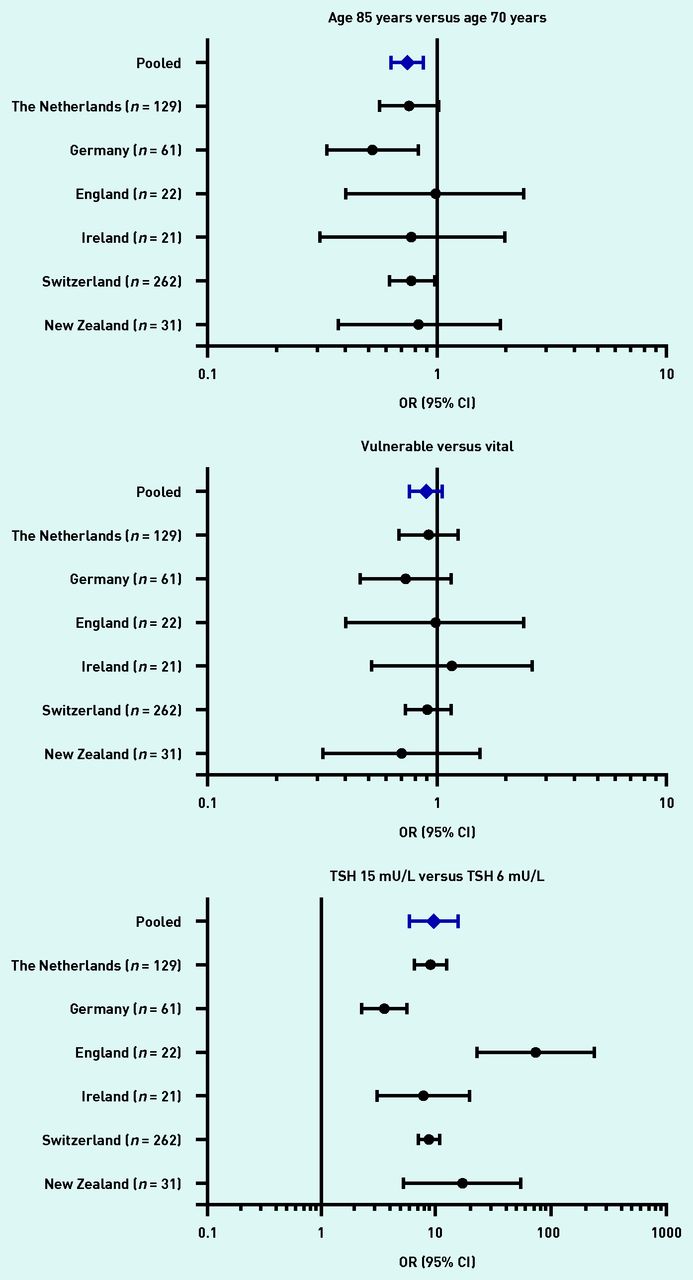

Chance of GP decision to start treatment per country dependent on age, vitality status, and TSH.
GPs in all countries indicated that their treatment strategy would not change for a male patient (percentage ‘no change’: Netherlands 97%, Germany 98%, England 91%, Ireland 100%, Switzerland 96%, and New Zealand 100% P = 0.44). No differences were observed in treatment decisions for GPs with fewer or more than 15 years of clinical experience. However, male GPs seemed more inclined to start treatment than female GPs, in particular for vulnerable patients, and for patients with TSH above 15 mU/L (data not shown).
DISCUSSION
Summary
In the present survey, a large variation in GP treatment strategies of older people with subclinical hypothyroidism was found, by country and also by patient characteristics. GPs from the Netherlands, England, and New Zealand were less inclined to start treatment than GPs in Germany, Ireland, and Switzerland. Overall, GPs were more likely to start treatment with higher TSH and younger age.
Strengths and limitations
One of the strengths of this survey is the international approach and use of a short online questionnaire that was sent out to a large number of GPs in a number of different countries. A limitation of this study is the low response rates in England, Ireland, and New Zealand in particular. The differences in response rates between countries may be explained by the constitution of the different networks. In general, the response rates were higher in countries where the survey was forwarded to GPs affiliated with a research and teaching network. Although the overall response rate in this study was comparable to a case-based survey on subclinical hypothyroidism among primary care physicians in the US,20 the low response impaired generalisability and prohibited performing a paired analysis. However, sensitivity analyses using only data from the Netherlands, Germany, and Switzerland showed similar results as when using data from all countries. Interestingly, if there was observation of variations among GPs within research and teaching networks, where evidence-based guidelines are often provided, then actual variations might be even greater. In addition, for practical reasons, GPs were not presented with cases with differences in symptoms and certain procedure options, for example, watchful waiting or repeated thyroid function assessments. These could also be interesting topics for further research.
Comparison with existing literature
The results build on evidence from earlier studies. In a previous case-based survey in the US, primary care physicians and American Thyroid Association members chose different treatment strategies for patients with thyroid failure.20 Another study using data from the Birmingham Elderly Thyroid Study (BETS) showed large variation in interpretation of symptoms and thyroid function tests in older individuals, and, consequently, large differences in therapy initiation between GPs in 19 UK practices.21 In addition, a focus group study among GPs in New Zealand also revealed considerable variability in how GPs defined and managed subclinical hypothyroidism.22 For example, in the survey the majority of the GPs in Ireland would start treatment in an 85-year-old vital female with TSH of 15 mU/L (68%), as recommended. However, this estimate also implicitly indicates that 32% would not start treatment. Therefore, the results confirm earlier findings about differences across physicians within countries, but add that treatment strategies also vary largely between countries.
The results reflect the lack of international consensus and the large variation in guidelines14–18 on whether or not to treat subclinical hypothyroidism, especially in older people. Although guidelines often provide specific recommendations for the treatment of older patients with overt hypothyroidism, they often do not provide specific recommendations for older patients with subclinical hypothyroidism. In the survey, the majority of GPs from England, Ireland, and New Zealand indicated they would initiate treatment in older females with TSH of 15 mU/L, which is in line with their national guidelines.16,17 In the Dutch guideline for GPs, it is not recommended to treat subclinical hypothyroidism.18 The GPs from the Netherlands were least likely to start treatment in all cases.
In Germany, thyroid hormones are among the most prescribed drugs. A recent cross-sectional study showed that 9% of patients in GP practices in Germany are taking thyroid medication.23 At present, in Germany, guidelines for GPs are being developed. The exact reasons for the high prescription rates in Germany are not known.23 The current remuneration procedures of the German health system, and the lack of guidelines, may perhaps explain why the GPs from this country were more often inclined to start treatment than in the other countries, and chose higher starting doses.
In the study, GPs less often indicated to start treatment in 85-year-olds than in 70-year-olds. In addition, patients with a TSH of 15 mU/L were more likely to get treated than patients with a TSH of 6 mU/L. These findings are in line with a previous case-based survey among primary care physicians and thyroid specialists in the US in which physicians adopted a more conservative treatment strategy (with lower starting dose) for older patients with mild thyroid failure than for young patients.20 Although no differences were observed in treatment decision for vital and frail older females, treatment decisions may also depend on various patient, doctor, and healthcare characteristics (for example, age, TSH level, sex of the GP, health insurance, or medication costs).
Implications for practice
Taken together, the findings highlight the importance of the development of evidence-based guidelines that provide decision support for the management of subclinical hypothyroidism for all age groups,22 and adequate implementation strategies for these guidelines. For the development of international consensus, more empirical data in the oldest age group are needed to establish whether or not treating older people with subclinical hypothyroidism is beneficial in terms of clinical outcomes. Currently, two large placebo-controlled RCTs are underway, both investigating the long-term benefits and risks of thyroxine treatment in older people with persistent subclinical hypothyroidism. In TRUST (Thyroid Hormone Replacement for Subclinical Hypo-Thyroidism Trial), start date February 2013, approximately 3000 patients are currently being recruited (NCT01660126, www.trustthyroidtrial.com) from Glasgow (UK), Leiden (the Netherlands), Cork (Ireland), and Bern (Switzerland). In the IEMO 80-plus thyroid trial, an additional 450 people aged ≥80 years and over will participate in a multicentre study in the Netherlands (NTR3851, www.iemoschildklierstudie.nl).
In conclusion, GP treatment strategies of older people with subclinical hypothyroidism vary not only by patient characteristics but also greatly by country. These large inter-physician and inter-country variations reflect lack of evidence and therefore underline the need for a new generation of international guidelines based on the outcomes of randomised clinical trials.
Acknowledgments
We thank Dagmar Haller-Hester (Department of Community Medicine and Primary Care, Geneva University Hospitals, Geneva, Switzerland) and Thomas Bischoff (Institute of General Medicine, University of Lausanne, Lausanne, Switzerland) for distributing the survey among GPs in their university networks. We hereby thank the Bern Institute of General Practice, University of Bern, Bern, Switzerland, for distribution of the survey in the university GP network. We thank Angela Robinson for sending the surveys in the Auckland region.
Appendix 1.
| Country | Guideline | Treatment TSH >10 mU/L | Treatment TSH <10 mU/l | Aspecific complaints | Specific recommendation for older people |
|---|---|---|---|---|---|
| Netherlands18 | + | − | − | − | + |
| Germanya | − | ? | ? | ? | ? |
| UK16 | + | + | − | + | − |
| Irelandb | + | + | − | + | − |
| Switzerlandc | − | + | ±d | + | + |
| New Zealand17 | + | + | − | + | − |
| US15 | + | + | + | + | + |
↵a An evidence based guideline is under development.
↵b The guidelines used in the Republic of Ireland are based on the guidelines originated in the UK.
↵c At present, no guideline is available, but good clinical practice is recommend by the Schweizerische Gesellschaft für Endokrinologie und Diabetologie (SGED): http://www.sgedssed.ch/fileadmin/files/dokumente/EDM_Key_Slides_2010-2011/SGED_Subklinische_Hypo_Hyperthyresose.pdf (accessed 2 Dec 2014).
↵d If TSH <10 mU/L and cardiovascular risk factors are present, then thyroxine treatment is recommended.
Summary of GP guidelines and treatment recommendations regarding subclinical hypothyroidism in different countries
Appendix 2. Survey (English version)
What is your gender?
□ Male
□ Female
How many years have you been practising as a GP?
□ <5
□ 5–10
□ 11–15
□ 16–20
□ 21–25
□ >25
What percentage of patients in your practice is 65 years or above?
□ <10
□ 10–20
□ 20–30
□ >30
When did you last diagnose a patient over 65 with subclinical hypothyroidism in your practice?
□ Less than 1 week ago
□ Less than 1 month ago
□ Less than 1 year ago
□ Less than 3 years ago
□ More than 3 years ago
When did you last start thyroxine treatment in a patient over 65 with subclinical hypothyroidism?
□ Less than 1 week ago
□ Less than 1 month ago
□ Less than 1 year ago
□ Less than 3 years ago
□ More than 3 years ago
□ Never
In each case we discuss an older woman of average height and weight, presenting with a specific complaints of fatigue. You found sufficient reason in her complaints to perform a blood test. The test showed subclinical hypothyroidism.
Case 1
Female, 70 years old, vital.
Elevated TSH: 6 mU/L (reference range 0.5–4.4 mU/L).
Free T4 is within the reference range (13–25 pMol/L).
Would you start thyroxine treatment?
□ Yes
□ No • go to question 6c
To start treatment, how much thyroxine (mcg) would you prescribe?
Explanation (optional)
Case 2
Female, 85 years old, vulnerable.
Elevated TSH: 6 mU/L (reference range 0.5–4.4 mU/L).
Free T4 is within the reference range (13–25 pMol/L).
Would you start thyroxine treatment?
□ Yes
□ No • go to question 7c
To start treatment, how much thyroxine (mcg) would you prescribe?
Explanation (optional)
Case 3
Female, 70 years old, vital.
Elevated TSH: 15 mU/L (reference range 0.5–4.4 mU/L).
Free T4 is within the reference range (13–25 pMol/L).
Would you start thyroxine treatment?
□ Yes
□ No • go to question 8c
To start treatment, how much thyroxine (mcg) would you prescribe?
Explanation (optional)
Case 4
Female, 70 years old, vulnerable.
Elevated TSH: 15 mU/L (reference range 0.5–4.4 mU/L).
Free T4 is within the reference range (13–25 pMol/L).
Would you start thyroxine treatment?
□ Yes
□ No • go to question 9c
To start treatment, how much thyroxine (mcg) would you prescribe?
Explanation (optional)
Case 5
Female, 85 years old, vital.
Elevated TSH: 6 mU/L (reference range 0.5–4.4 mU/L).
Free T4 is within the reference range (13–25 pMol/L).
Would you start thyroxine treatment?
□ Yes
□ No • go to question 10c
To start treatment, how much thyroxine (mcg) would you prescribe?
Explanation (optional)
Case 6
Female, 85 years old, vital.
Elevated TSH: 15 mU/L (reference range 0.5–4.4 mU/L).
Free T4 is within the reference range (13–25 pMol/L).
Would you start thyroxine treatment?
□ Yes
□ No • go to question 11c
To start treatment, how much thyroxine (mcg) would you prescribe?
Explanation (optional)
Case 7
Female, 85 years old, vulnerable.
Elevated TSH: 15 mU/L (reference range 0.5–4.4 mU/L).
Free T4 is within the reference range (13–25 pMol/L).
Would you start thyroxine treatment?
□ Yes
□ No • go to question 12c
To start treatment, how much thyroxine (mcg) would you prescribe?
Explanation (optional)
Case 8
Female, 70 years old, vulnerable.
Elevated TSH: 6 mU/L (reference range 0.5–4.4 mU/L).
Free T4 is within the reference range (13–25 pMol/L).
Would you start thyroxine treatment?
□ Yes
No • go to question 13c
To start treatment, how much thyroxine (mcg) would you prescribe?
Explanation (optional)
Would you act any differently if the patient was an older male of average weight and normal BMI instead of a woman?
□ Yes, go to 14b
□ No, go to 15
Explanation
Would you like to be informed about the results of this study?
□ Yes • email address
□ No
Comments:
Appendix 3. Chance of GP decision to start treatment per country dependent on patient characteristics
| Countries, OR (95% CI) | P-value | |||||||
|---|---|---|---|---|---|---|---|---|
| Netherlands n = 129 | Germany n = 61 | England n = 22 | Ireland n = 21 | Switzerland n = 262 | New Zealand n = 31 | Pooled OR (random effects) | ||
| Age 85 versus age 70 years (reference) | 0.76 (0.56 to 1.02) | 0.52 (0.33 to 0.83) | 0.98 (0.40 to 2.39) | 0.77 (0.31 to 1.96) | 0.77 (0.62 to 0.97) | 0.83 (0.37 to 1.88) | 0.74 (0.63 to 0.87) | <0.01 |
| Vulnerable versus vital (reference) | 0.92 (0.68 to 1.24) | 0.73 (0.46 to 1.16) | 0.99 (0.40 to 2.41) | 1.15 (0.52 to 2.57) | 0.91 (0.72 to 1.14) | 0.70 (0.32 to 1.54) | 0.89 (0.76 to 1.04) | 0.15 |
| TSH 15 versus TSH 6 mU/L (reference) | 8.89 (6.41 to 12.3) | 3.54 (2.25 to 5.59) | 73.4 (22.5 to 239) | 7.69 (3.02 to 19.6) | 8.57 (7.00 to 10.5) | 17.0 (5.26 to 55.1) | 9.49 (5.81 to 15.5) | <0.01 |
OR = odd ratios.
Notes
Funding
This work was supported by TRUST (HEALTH-FP7-2011-278148) and IEMO Thyroid Trial (Dutch Ministry of Health and Welfare, ZonMw 627001001). Vanessa Virgini’s and Nicolas Rodondi’s work was supported by a research grant from the Swiss National Science Foundation (SNSF 320030-138267). The sponsor had no role in the design and conduct of the study; in the collection, analysis, and interpretation of the data; or in the preparation, review, or approval of the manuscript.
Ethical approval
The authors were exempt from obtaining ethical approval from ethics committees in the Netherlands, Germany, England, Switzerland, and New Zealand. In Ireland, the Clinical Research Ethics Committee of the Cork Teaching Hospital approved the study (references ECM 4 (oo) 12/06/12 and ECM 3 (w) 03/07/12).
Provenance
Freely submitted, externally peer reviewed.
Competing interests
The authors have declared no competing interests.
Discuss this article
Contribute and read comments about this article: bjgp.org/letters
- Received February 17, 2014.
- Revision requested April 23, 2014.
- Accepted May 13, 2014.
- © British Journal of General Practice 2015
REFERENCES
In this issue


Jump to section
More in this TOC Section
Related Articles
Cited By...

